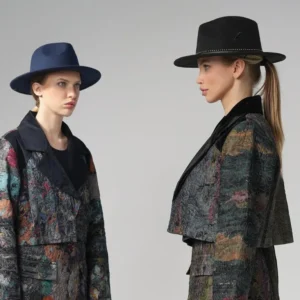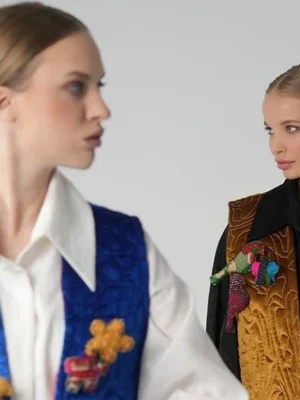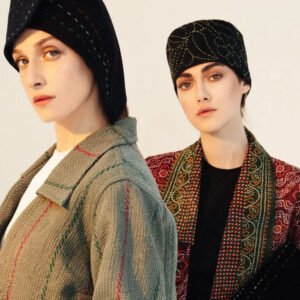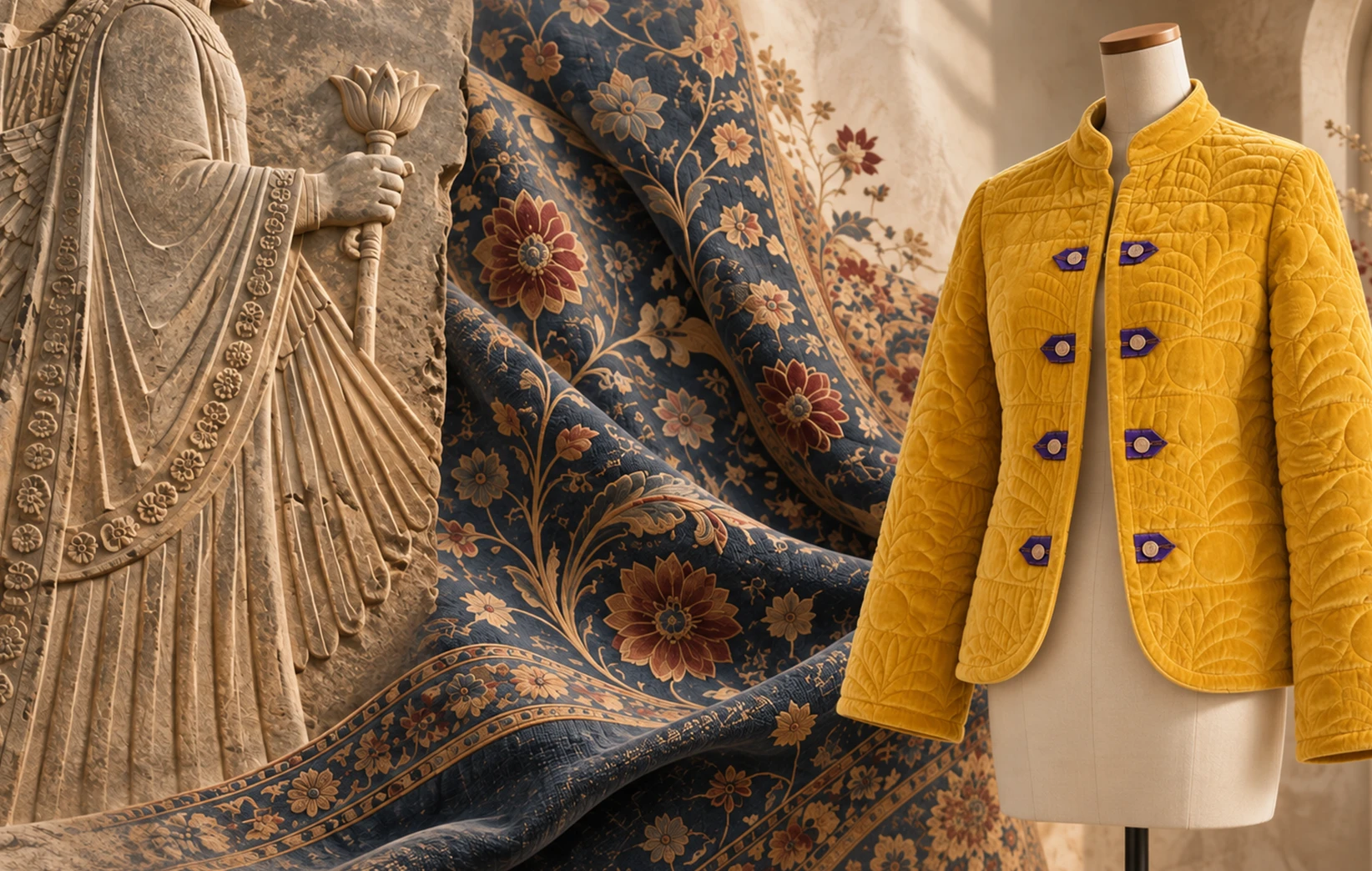
A carved robe at Persepolis and a contemporary coat made in Tehran belong to very different worlds. Yet both offer a way to ask the same questions: what did people choose to wear, what could they wear, and what did their clothes communicate?
The history of fashion in Iran includes court ceremony, regional dress, textile production and changes imposed by the state. Some garments survive; others are known through images and written accounts. Together, these records reveal a history of changing tastes rather than one national style carried unchanged through the centuries.
This brief overview follows several important periods. For an introduction to the wider subject, including regional clothing and current design, read What Is Iranian Fashion?
Ancient Persia: Reading Dress Through Images
The Achaemenid Empire, conventionally dated to 550–330 BCE, provides a substantial visual record of ancient dress. Reliefs at Persepolis and Naqsh-e Rostam, glazed-brick figures and seals show garments worn by rulers, attendants, soldiers and delegations from different peoples.
As Encyclopaedia Iranica’s study of Median and Achaemenid clothing explains, the evidence includes both loose, draped court dress and more fitted clothing associated with riding. Headgear, trousers, footwear and the arrangement of fabric help distinguish the figures.
These images are valuable, but they have limits. Much of the evidence concerns men, and ceremonial representations cannot tell us everything about everyday clothing. Nor should the dress of an imperial court be treated as a single outfit shared by everyone within its borders.
Between the Achaemenids and the Safavids
There is a long history between ancient court dress and the textiles for which Safavid Iran is celebrated. It should not disappear simply because a short survey moves quickly across it.
For the Sasanian period, 224–651 CE, reliefs, mosaics and metalwork provide evidence of tunics, trousers, robes and elaborate accessories. Iranica’s account of Sasanian clothing also traces relationships with dress in neighbouring regions. The surviving representations of women are fewer than those of men, making broad conclusions difficult.
The intervening centuries deserve their own detailed study. Here, the important point is that Iranian dress had already passed through many changes before the Safavid dynasty began. Later clothing emerged from that longer history, not from a single moment of invention.
Safavid Iran: Clothing, Textiles and Courtly Expression
The Safavid period, 1501–1722, is particularly well documented through paintings, textile fragments and travellers’ accounts. Its clothing could communicate political allegiance and literary taste as well as wealth.
The Metropolitan Museum of Art’s study of Safavid fashion describes layered garments, striking colour combinations and patterned fabrics enriched with gold- and silver-wrapped threads. Some woven designs depicted figures and stories from Persian literature.
Headwear could carry a more explicit message. The distinctive cap and turban associated with Shah Isma‘il and his supporters served as a visible sign of allegiance. Elsewhere in the ensemble, robes, shirts and trousers created combinations of colour and texture.
Under Shah Abbas I, whose reign is dated by the Met to 1587–1629, luxury textile production and trade received strong support. Workshops in Yazd, Kashan and Isfahan produced silks and velvets for clothing and furnishings.
Safavid dress also changed over time. Later examples show shifts towards more fitted garments. The period offers a range of references for designers today, rather than one fixed “Safavid look.”
Qajar Dress: New Influences and a Photographic Record
During the Qajar period, ending in 1925, clothing continued to change through local practice, court taste and contact with European materials and styles. Layering, ornament and textile quality remained important, but garments and their proportions were not identical throughout the period.
Photography expanded the evidence available to historians. Nineteenth-century images complement paintings, written descriptions and surviving clothes, showing how garments were combined and worn.
Iranica’s study of Safavid and Qajar dress draws on these different records. Court photographs are especially useful, though they should not stand in for the clothing of every household or region.
Reading the evidence closely gives a more interesting picture than a simple progression towards greater ornament: styles changed, materials circulated, and people adapted clothing to different settings.
The Pahlavi Period: Dress as State Policy
In the twentieth century, the state intervened directly in clothing. The 1928 uniform dress law required Western-style clothing for men, with specified exemptions. A further decree in 1935 required brimmed hats, provoking opposition; security forces killed protesters at the Goharshad Mosque in Mashhad.
In January 1936, Reza Shah imposed unveiling on women. Enforcement was coercive, and some women avoided public life rather than appear without their customary coverings.
After his abdication in 1941, many resumed wearing the veil. Others continued to follow European fashions. These developments, documented in Iranica’s account of Pahlavi and post-Pahlavi clothing, show how dress became bound to state policy and personal freedom.
After 1979: New Requirements for Public Dress
Following the 1979 Revolution, public dress requirements gradually changed, making covered clothing and headscarves a standard part of women’s public attire. These changes took shape over several years.
Outer layers and head coverings became central to public womenswear. The history of these requirements is important, but public dress alone does not describe every garment made or worn in Iran.
Contemporary Design: Working with What Came Before
Historical references now appear in contemporary collections in many forms. A designer might work with a traditional textile, study the proportions of a regional garment or use a motif as the starting point for a new silhouette. Others pursue ideas with few visible heritage references.
Research into Tehran’s fashion scene in the early 2000s already described designers negotiating between cultural references, clients’ expectations and restrictions on dress. That study of couture in Tehran is evidence of an active design culture; contemporary Iranian fashion cannot be explained simply as a recent return after decades in which creativity disappeared.
Naghmeh Kiumarsi offers one example of how heritage enters this work. A Tehran-based designer with an international career, she draws on Iranian art and textile craft in contemporary womenswear. Her design background and career connect local studio practice with presentations abroad.
In her interview on Iranian culture and fashion design, Kiumarsi discusses her Shah Abbas garden collection and the research behind its Safavid references. Historical forms become decisions about fabric, cut and detail.
Her 2025 collection presented in Cannes takes a different starting point: clothing associated with twelve Iranian communities. It brings regional dress into a contemporary interpretation, widening the conversation beyond courtly heritage.
What This History Brings to a Modern Garment
Knowing the history changes what we notice. A textile can reveal a method of making; a silhouette can recall an earlier form of dress. Research can also show where a familiar story is incomplete or where a claimed connection needs more evidence.
Some traditions continue through making and use. Others are recovered from archives or reinterpreted at a distance. These are different kinds of connection, and each deserves to be described carefully.
Explore Naghmeh Kiumarsi’s collections to see how one designer turns historical and cultural references into clothing for the present.