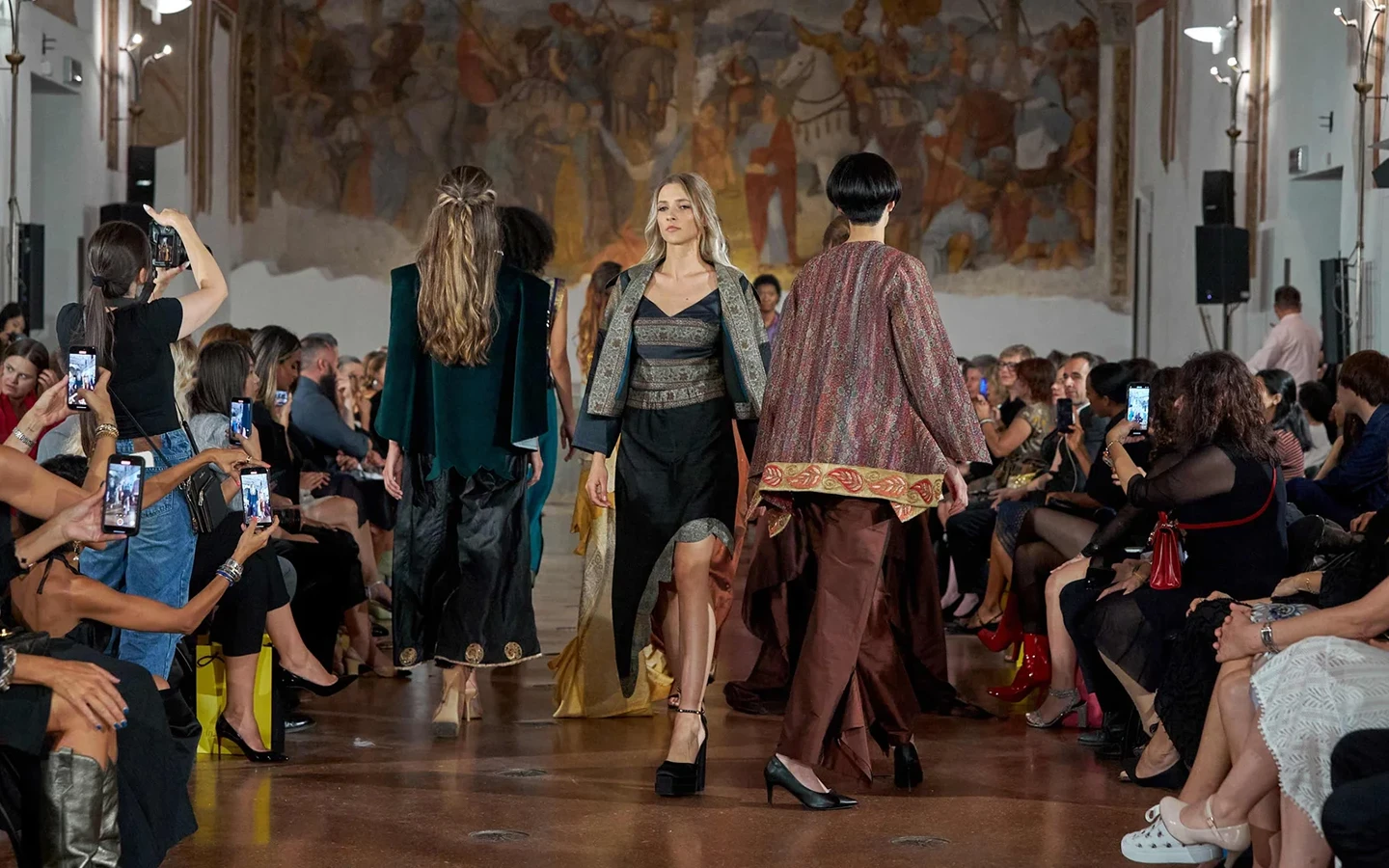
Iran holds one of the oldest and least understood design traditions in the world. It carries patterns that trace back to the Achaemenid Empire, fabrics perfected over centuries in Yazd and Isfahan, and a modern movement of designers pushing those roots onto global runways. This guide covers the full picture: historical origins, regional attire, signature textiles, and how contemporary designers like Naghmeh Kiumarsi are bringing this heritage to Milan, Cannes, and beyond.
What Is Iranian Fashion?
Iranian fashion refers to the clothing traditions of Iran and the Persian cultural sphere, spanning thousands of years of history and dozens of distinct regional styles. It is not one single look. A silk termeh coat from the Safavid court, a Qashqai wedding dress, and a manteau designed in Tehran last year are all part of the same broader story, but they look almost nothing alike.
What ties Iranian fashion together isn’t a uniform aesthetic. It’s a shared set of ingredients: handwoven textiles developed over centuries, a visual language of motifs drawn from Persian art and poetry, and a strong sense of regional identity carried through clothing worn by dozens of ethnic communities across the country. Contemporary Iranian fashion designers draw on all three, often combining pre-Islamic Persian imagery with modern silhouettes built for international audiences.
This is also why Iranian fashion has become genuinely interesting to people outside Iran in the last decade. It offers something most Western fashion doesn’t: patterns and techniques with a documented history stretching back thousands of years, still being reinterpreted by living designers rather than treated as museum pieces.
Iranian Fashion vs. Persian Fashion: Is There a Difference?
People often use “Iranian” and “Persian” interchangeably when talking about fashion from this part of the world, and in most everyday contexts that’s fine. Technically, “Persian” refers to the ethnic Persian people and the historical Persian Empire, while “Iranian” refers to the modern nation of Iran, which is home to Persians as well as Kurds, Azeris, Qashqai, Turkmen, Baloch, and many other groups. So a Kurdish dress or a Qashqai skirt is Iranian, but not, strictly, Persian. In practice, most articles, including this one, use “Persian” for historical art, textiles, and motifs that trace back to specific Persian dynasties like the Safavids, and “Iranian” as the broader umbrella term for the country’s fashion as a whole, past and present. For a closer look at how this distinction plays out, see What Is Iranian Fashion?.
A Brief History of Fashion in Iran
The evolution of dress in Iran reflects shifting empires, trade routes, and cultural revolutions.
Ancient Persia. Clothing in the Achaemenid Empire (550 to 330 BCE) already carried strong social meaning. Fabric, color, and cut signaled rank, and the tradition of using clothing to communicate status and identity, rather than just cover the body, has stayed a constant thread through Iranian fashion ever since.
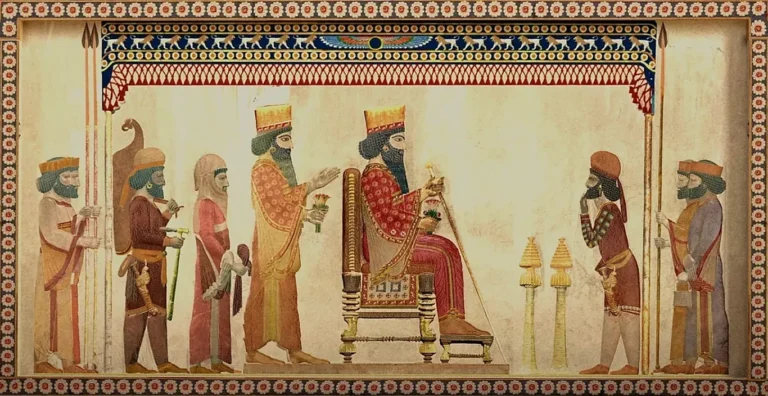
The Safavid era. Persian fashion reached one of its high points under the Safavid dynasty, particularly during the reign of Shah Abbas I in the 16th and 17th centuries. This period produced the termeh weaving tradition in its recognizable form and gave rise to the Shah Abbasi floral motif, named after the ruler himself, which still appears on textiles, rugs, and clothing today. Royal workshops in Isfahan brought in designers from as far as China and Armenia, which is part of why Persian textile design from this era carries such a distinct, layered visual style.
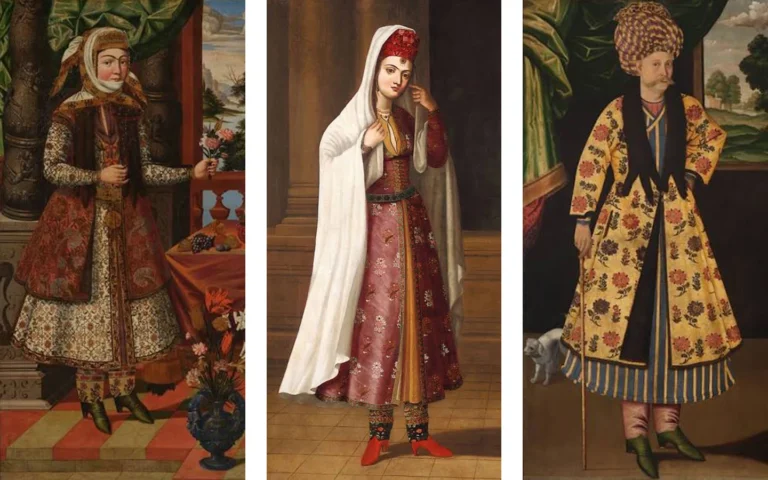
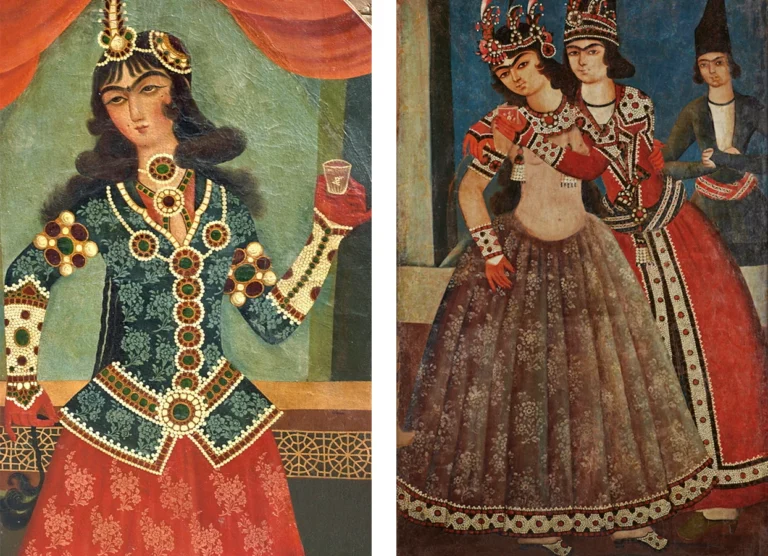
The Qajar period (1789 to 1925). Clothing became more elaborate, with intricate embroidery, richer color palettes, and greater use of luxury fabrics like silk and velvet. Men typically wore long coats and tall hats, while women wore colorful, layered dresses paired with ornate jewelry. Foreign trade during this period also introduced new fabrics and influences into Iranian tailoring.
The Pahlavi era (1925 to 1979). Western fashion made a significant entrance into Iranian society during this period, and Western-style clothing became common, particularly in cities.
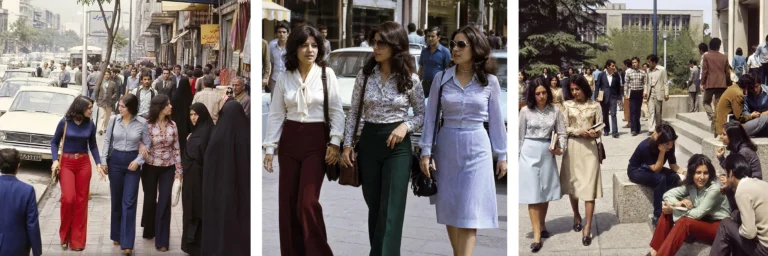
After the 1979 revolution. The Islamic Revolution changed Iranian fashion more than any other single event in its modern history. Public dress codes became mandatory, and for years afterward, domestically produced clothing options were often described as limited and uninspired, pushing many Iranian women toward Western brands adapted to fit modesty requirements. Chadors and manteaus (long, fitted overcoats) became everyday staples.
The 1980s and 1990s. In the years right after the revolution, fashion largely took a back seat to broader social and economic concerns. The chador remained common, and the manteau became the standard formal option for women who wanted an alternative. Domestic design during this period was, by most accounts, fairly limited in variety, which is part of why Western brands remained so appealing to Iranians who could access them.
The last two decades. Over the past twenty years, a new generation of designers began viewing modest dress codes not as a creative barrier, but as an opportunity for innovation. Brands built manteaus and headscarves with better cuts, brighter colors, and genuine style, while other designers went further, reviving pre-Islamic Persian motifs and ancient textile techniques and putting them into modern silhouettes aimed at both Iranian and international audiences. That’s the environment contemporary Iranian fashion designers, including Naghmeh Kiumarsi, are working in today, and it’s also part of a much larger global shift: modest fashion as a category, across many countries and religions, has grown into an industry estimated at $44 billion a year, with major retailers from Uniqlo to Paris couture houses now offering modest lines. Iran’s own designers are one part of that much bigger picture.
For the full walk through these eras, see A Brief History of Fashion in Iran.
Traditional Persian clothing: A Country of Many Styles
One of the most common misconceptions about Iranian clothing is that it’s one style. In reality, Iran is home to dozens of ethnic groups, and each has its own traditional dress, often with its own color palette, embroidery style, and silhouette. Here are some of the most recognizable.
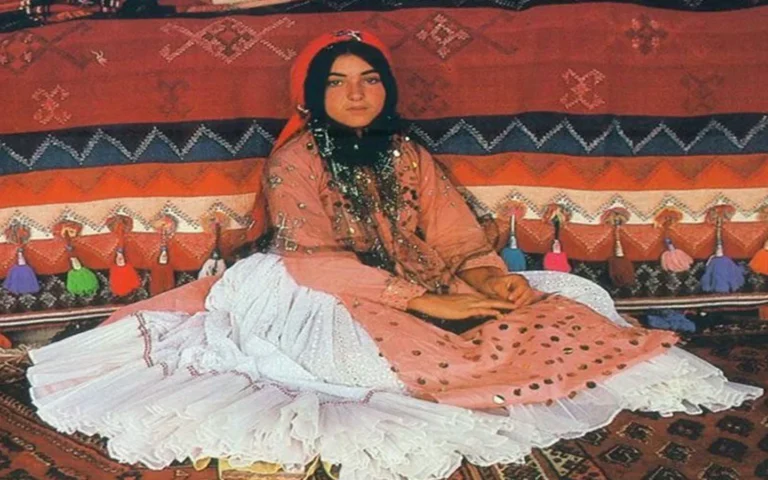
Qashqai. The Qashqai are a semi-nomadic Turkic people from southern Iran, and their traditional dress is known for long, layered, brightly colored skirts, fitted tops, and elaborate headscarves, often finished with coin jewelry and embroidery.
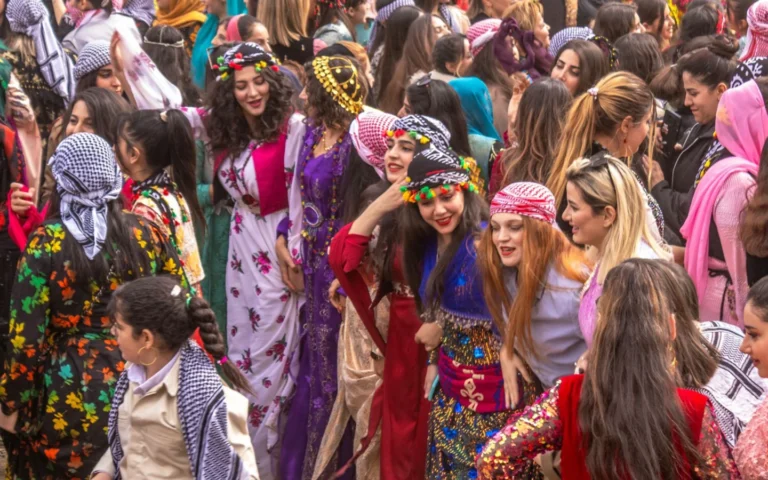
Kurdish. Kurdish traditional clothing, worn in western Iran, typically features wide-legged trousers, a fitted vest or jacket, and a long tunic, often in rich colors with detailed embroidery along the cuffs and collar.
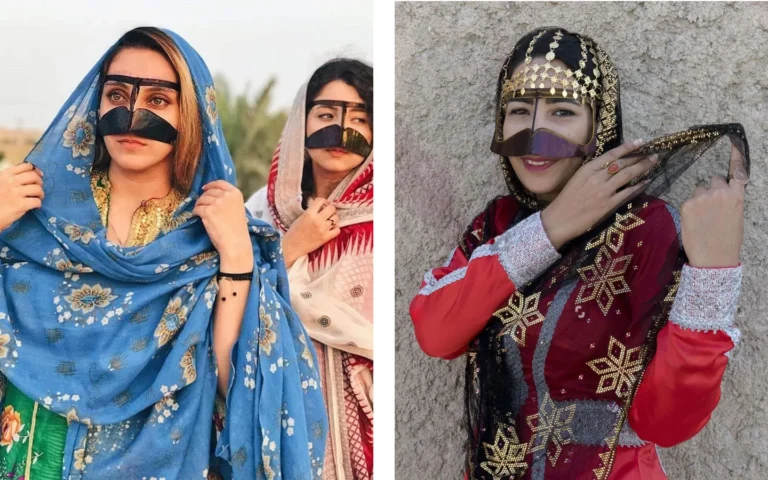
Bandari. In Hormozgan province, in southern Iran along the Persian Gulf, women wear bandari dress: brightly colored, heavily embroidered gowns that reflect the region’s cultural ties to both Persia and the Arabian Peninsula, often paired with a distinctive face mask called a burqa in some communities.
Gilaki and Mazani. In the northern provinces of Gilan and Mazandaran, traditional women’s dress includes layered skirts, colorful blouses, and patterned headscarves, styles still worn during festivals and celebrations.
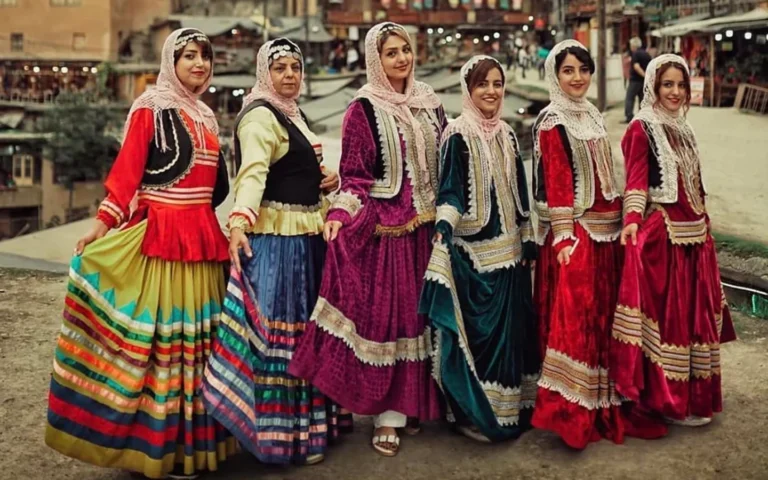
Turkmen. Turkmen dress, found in northeastern Iran, is known for its rich red tones, heavy silver jewelry, and detailed embroidery, often signaling both regional identity and, in older tradition, a woman’s marital status.
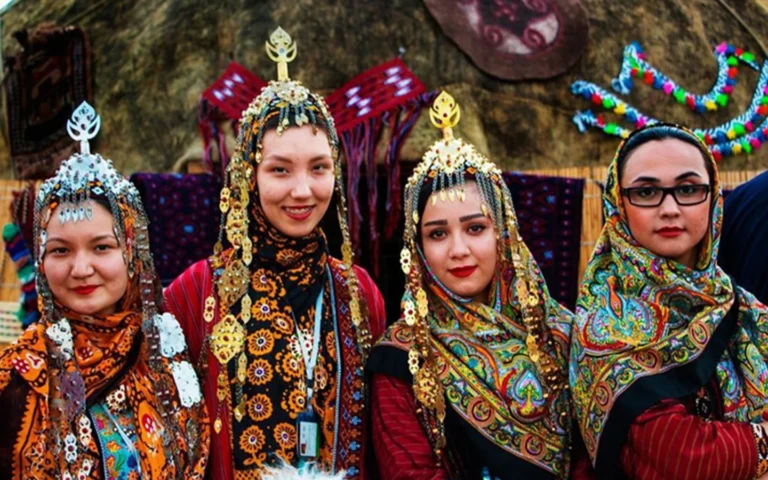
Naghmeh Kiumarsi’s 2025 Cannes Fashion Week collection drew directly on this diversity, reinterpreting traditional attire from twelve different Iranian ethnic groups, including Qashqai, Kurdish, Turkmen, Bandari, Mazani, and Gilaki dress, through a contemporary design lens.
What makes this regional diversity so valuable to contemporary designers is that it’s still a living practice, not a historical record. Traditional dress from these communities is worn at weddings, Nowruz celebrations, and regional festivals every year, which means designers working with these references are drawing on something people still recognize and wear, not something they only see in a museum case. The full picture of each region’s dress, fabric, and jewelry is covered in Iranian Traditional Clothing.
The Textiles Behind Iranian Fashion
Iranian fashion is inseparable from Iranian textile craft. A few fabrics come up again and again in both historical and contemporary Iranian design.
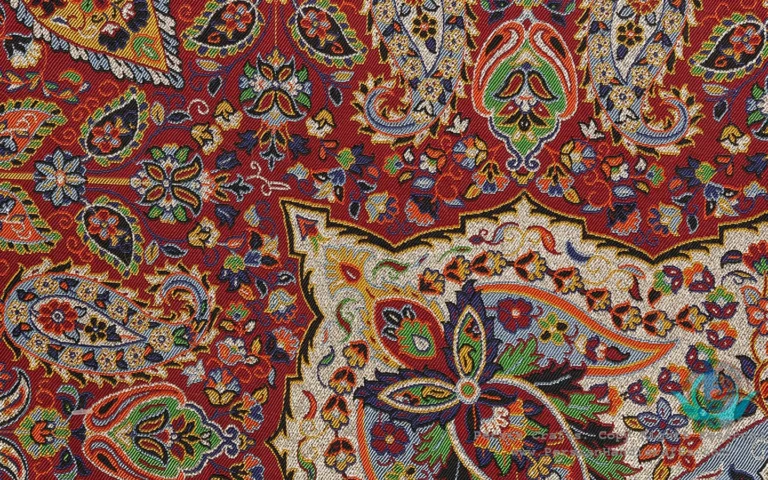
Termeh. A richly patterned fabric traditionally woven from silk and wool, termeh has been produced in Iran for centuries, with production concentrated in Yazd. Its most recognizable feature is the boteh, a teardrop-shaped motif that later became known internationally as the paisley pattern. Termeh weaving reached particular refinement during the Safavid period and remains part of Iranian weddings and formal ceremonies today, used for everything from tablecloths to clothing.
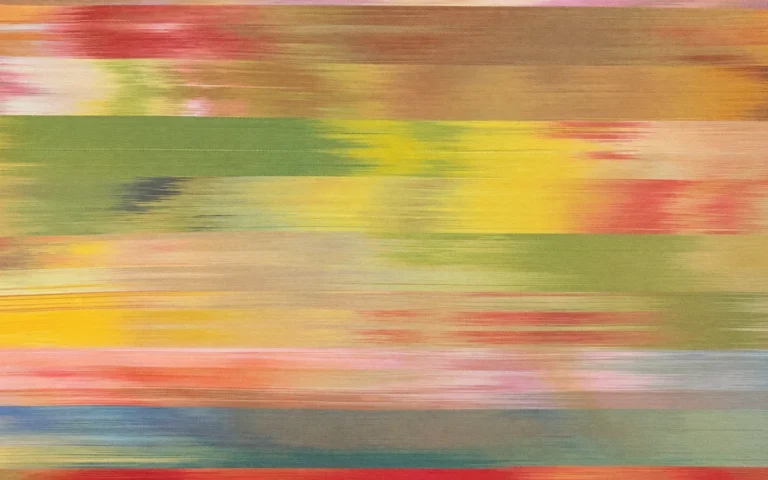
Ikat (Daraayi). Known in Iran as daraayi, Persian ikat is a hand-woven silk textile associated with the city of Yazd, with a weaving history estimated at around 800 years. Its geometric, slightly blurred patterns come from a resist-dyeing technique applied to the threads before weaving. The name daraayi, meaning “asset” in Persian, reportedly comes from its historical role as a valuable part of a bride’s dowry.
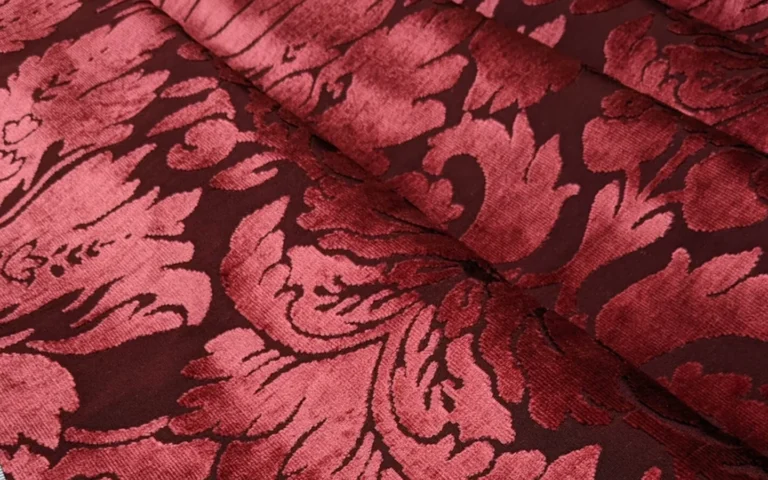
Velvet and silk. Iranian velvet, often combined with termeh or embroidery, has long been used for higher-end formal wear, and continues to appear in contemporary designer collections that reference Safavid-era luxury.
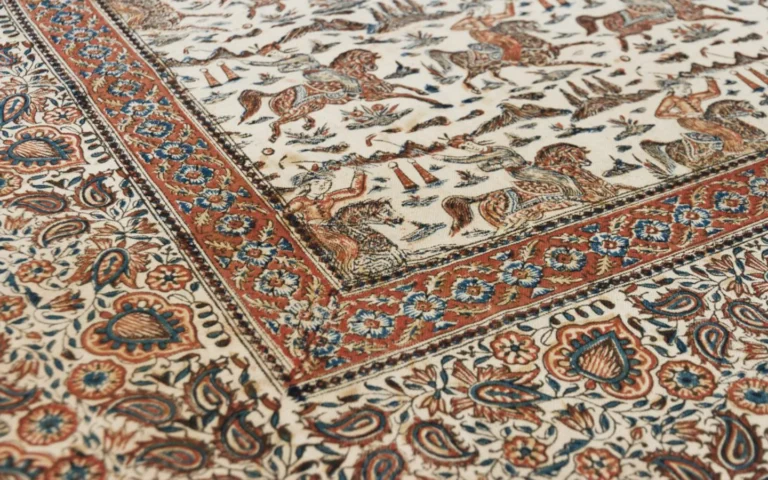
Ghalamkar. A hand block-printed cotton textile, traditionally produced in Isfahan, ghalamkar uses hand-carved wooden stamps to apply intricate floral and figurative patterns onto fabric, often finished with natural dyes. It’s used for everything from tablecloths to clothing and remains one of Iran’s more recognizable textile crafts internationally.
These aren’t just historical curiosities. Naghmeh Kiumarsi’s “Flowers of Shah Abbas Garden” collection, shown at Milan Fashion Week, used velvet and termeh fabrics directly, pairing them with raw silk to bring a Safavid-era textile vocabulary into a modern runway collection. This kind of material choice is also part of why Iranian fashion connects so naturally with the slow fashion movement, since these textiles were never designed for mass production in the first place. Each of these fabrics is broken down in more depth in [Persian Textiles].
Motifs That Define Persian Design
If Iranian textiles are the material, Persian motifs are the language written on top of them. Two show up more than any others.
The Shah Abbasi motif. Commissioned during the reign of Shah Abbas I to decorate tilework in Isfahan, this stylized floral design (often described as a rendering of a narcissus flower) spread from architecture into rug weaving and textile design, and remains one of the most recognizable patterns in Persian art. It typically appears as a rounded, symmetrical flower form, often in a repeating field or along a border.
Eslimi. Also known as Islimi or Persian arabesque, this motif consists of continuous, spiraling vine work that connects other design elements, such as Shah Abbasi flowers, into a single flowing composition. Eslimi is considered one of the three foundational pillars of Islamic art, alongside calligraphy and geometry, and it represents an idea of underlying order and unity running through the natural world.
Calligraphy. Persian calligraphy, particularly Nastaliq script featuring lines of classical poetry, has also found its way onto contemporary clothing, adding a literary layer of meaning that ties fashion back to Iran’s long tradition of poetry.
These motifs are not simply decorative choices. When a contemporary Iranian designer uses a Shah Abbasi pattern on a piece of clothing, they are drawing a direct visual line back to 16th century Isfahan, whether the audience recognizes it or not.
Jewelry and Accessories in Persian Attire
Clothing is only part of the picture. Historically, Persian fashion placed real weight on accessories: ornate kohl containers, embroidered caps meant to symbolize protection and longevity, and hand-knitted socks with elaborate patterns, worn partly because shoes were traditionally removed indoors. Jewelry carried its own symbolic language, with specific motifs and materials signaling everything from regional identity to marital status, a tradition that still shows up in Turkmen silver jewelry today. Contemporary Iranian designers frequently draw on this accessory tradition as much as they draw on clothing itself, particularly headpieces, embroidered caps, and statement jewelry that echo historic forms. Both motifs are covered in full in [Persian Motifs & Art](LINK: Persian Motifs & Art).
Contemporary Iranian Fashion: Where Tradition Meets Modernity
Contemporary Iranian fashion sits at an interesting intersection. Public dress codes still shape what can be worn, particularly for women, but instead of treating that as a dead end, a growing number of designers have turned it into a genuine creative problem.
Some brands have focused on making mandated garments, like the manteau and headscarf, into something people actually want to wear. Anar Design, founded in 2006, became known for updating the manteau with vibrant, patterned fabrics and better tailoring, aimed at a younger, style-conscious audience. Other designers, like Poosh, built entire collections around merging global fashion trends with dress codes, rather than working against them.
A separate strand of contemporary Iranian fashion looks further back rather than to current trends, drawing on pre-Islamic Persian history and Safavid-era art to create pieces that read as distinctly Iranian rather than adapted Western fashion. This is where designers reviving Achaemenid and Safavid motifs, historic textiles like termeh and daraayi, and regional traditional dress have found an audience, both inside Iran and abroad. Naghmeh Kiumarsi’s work sits in this category, built around Persian calligraphy, poetry, and craft translated into contemporary womenswear.
The result is an industry that looks very different from a decade ago: still working within real restrictions, but no longer treating those restrictions as an excuse for uninspired design. This shift is explored in more depth in [Contemporary Iranian Fashion].
Iranian Fashion Designers Taking the World Stage
For a long time, Iranian fashion was largely unknown outside the country, or known only through stereotype. That’s changed, gradually, through the work of individual designers who took Iranian design to international audiences directly.
Arefeh Mansouri, who left Tehran for Canada at sixteen, built a career in high couture and avant-garde bridal wear, showing on runways at New York Fashion Week while keeping Persian fabrics, shapes, and color palettes at the center of her work.
Naghmeh Kiumarsi has built one of the more internationally visible careers among contemporary Iranian designers over more than two decades in the industry. Her “Flowers of Shah Abbas Garden” collection, inspired by the Shah Abbasi motif and built from velvet and termeh, showed at Milan Fashion Week to strong reception. In 2025, she presented a collection at Cannes Fashion Week reinterpreting traditional attire from twelve Iranian ethnic groups. Earlier in her career, following a presentation at the Edinburgh Iranian Festival, two of her pieces, a velvet jacket and a velvet top featuring miniature-style patterns, were acquired into the permanent World Culture collection at National Museums Scotland in 2015, one of the few instances of contemporary Iranian fashion entering a national museum collection.
This kind of international presence matters for more than one designer’s career. Every time a piece of contemporary Iranian fashion shows up on a runway in Milan or in a museum collection in Edinburgh, it becomes a little harder to reduce Iranian fashion to a single, flattened idea. It also gives Iranian designers direct access to audiences, retailers, and institutions that simply weren’t paying attention a generation ago. More on the individual designers building this reputation is in [Iranian Fashion Designers](LINK: Iranian Fashion Designers), and their runway and museum presence abroad is covered in [International Iranian Fashion].
Slow Fashion and the Iranian Design Philosophy
There’s a natural overlap between traditional Iranian design and the global slow fashion movement, even though the two developed independently.
Techniques like termeh weaving and daraayi ikat were never built for speed. A single termeh piece can take a skilled weaver a long time to complete by hand, using natural fibers and, historically, natural dyes. That kind of production stands in direct contrast to the fast fashion model built around rapid turnover and low-cost manufacturing.
Designers working with these techniques today, including those building collections around handwoven fabrics and hand embroidery, are participating in slow fashion by default, not because it’s trending, but because that’s how these materials have always been made. As global interest in sustainable and slow fashion grows, Iranian textile heritage offers something increasingly rare: production methods with a genuine, centuries-old track record of durability and craftsmanship, rather than something invented recently to meet a marketing trend. This connection is unpacked further in [Slow & Sustainable Fashion].
Why Iranian Fashion Is Worth Paying Attention to Now
Iranian fashion sits at a genuinely interesting point right now. It has thousands of years of textile and design history to draw on, a living community of ethnic traditions still practiced today, and a generation of designers actively translating all of it into contemporary clothing rather than letting it sit in museums.
That combination, deep history plus active reinterpretation, is rare. Most fashion traditions with this much history are treated as heritage to preserve, kept behind glass rather than worn. Iranian fashion, through designers like Naghmeh Kiumarsi and others working across the industry, is instead being actively used, reworked, and shown to new audiences on runways from Tehran to Milan to Cannes. It is also, quietly, part of a much larger global conversation about what fashion looks like when it isn’t built around speed and disposability, which is exactly why the slow fashion movement and Iranian textile heritage keep intersecting.
For anyone building a wardrobe, a collection, or simply an understanding of where global fashion is heading next, Iranian fashion is not a niche curiosity. It’s one of the more substantial design traditions currently being reintroduced to the world, and it’s happening now, not fifty years ago.
If you want to go deeper into any part of this story, from the specific traditional dress of Iran’s ethnic communities to the textiles and motifs behind it, the guides linked throughout this page are the place to start.
Frequently Asked Questions
What is Iranian fashion known for? Iranian fashion is known for its handwoven textiles like termeh and daraayi ikat, its use of historic Persian motifs such as the Shah Abbasi flower and eslimi arabesque, and the strong regional diversity of traditional dress across its many ethnic communities.
Is Iranian fashion the same as Persian fashion? Not exactly. “Persian” technically refers to ethnic Persian culture and historical Persian dynasties, while “Iranian” is the broader term covering the modern country and all of its ethnic groups. In everyday use, the two terms are often used interchangeably.
Who are some well-known Iranian fashion designers? Designers who have built international recognition include Naghmeh Kiumarsi, known for collections shown at Milan and Cannes Fashion Weeks and pieces held in the National Museums Scotland collection, along with designers such as Arefeh Mansouri and Anousheh Assefi of Anar Design.
What fabrics are traditionally used in Iranian clothing? The most historically significant are termeh, a richly patterned silk and wool fabric associated with Yazd, daraayi (Persian ikat), also from Yazd, and hand block-printed ghalamkar cotton from Isfahan. Silk and velvet are also closely tied to more formal, historic Persian clothing.
How has Iranian fashion changed since 1979? Since the Islamic Revolution, public dress codes have required modest clothing for women in Iran, which for years limited domestic design options. Over the past two decades, however, a new generation of designers has focused on making modest clothing genuinely stylish, while others have looked further back, reviving pre-Islamic Persian motifs and traditional textiles in modern silhouettes aimed at both local and international audiences.
Where can I see Iranian fashion outside Iran? Iranian designers have shown work at international events including Milan Fashion Week, Cannes Fashion Week, and the Edinburgh Iranian Festival. Some pieces have also entered permanent museum collections, including two garments by Naghmeh Kiumarsi held by National Museums Scotland since 2015.
Sources
- Contemporary Muslim Fashions exhibition, Cooper Hewitt
- Termeh, Wikipedia
- Textile (termeh cloth), Smithsonian’s National Museum of Asian Art
- Ikat, Daraee Bafi Yazd, Iran Front Page
- Shah Abbasi floral design, Wikipedia
- Islimi, Nazmiyal Antique Rugs
- Traditional Clothing of Iran, EavarTravel
- Traditional Persian Clothing, Surf Iran
- Iran’s Fashion Beat: The Designers Turning Heads Right Now, SUITCASE Magazine
- The Iranian Fashion Designers Changing The Status Quo, The Culture Trip
- About Naghmeh Kiumarsi
- The Brilliance of Iranian Ethnic Attire at the Cannes Festival, Naghmeh Kiumarsi
- Flowers of Shah Abbas Garden, Milan Fashion Show, Naghmeh Kiumarsi